Why an architect built a cognitive operating system
TALOS wasn’t an idea generated by the AI boom. It’s the convergence of twenty years spent learning how human systems fail — and one mind built to notice it earlier than most.
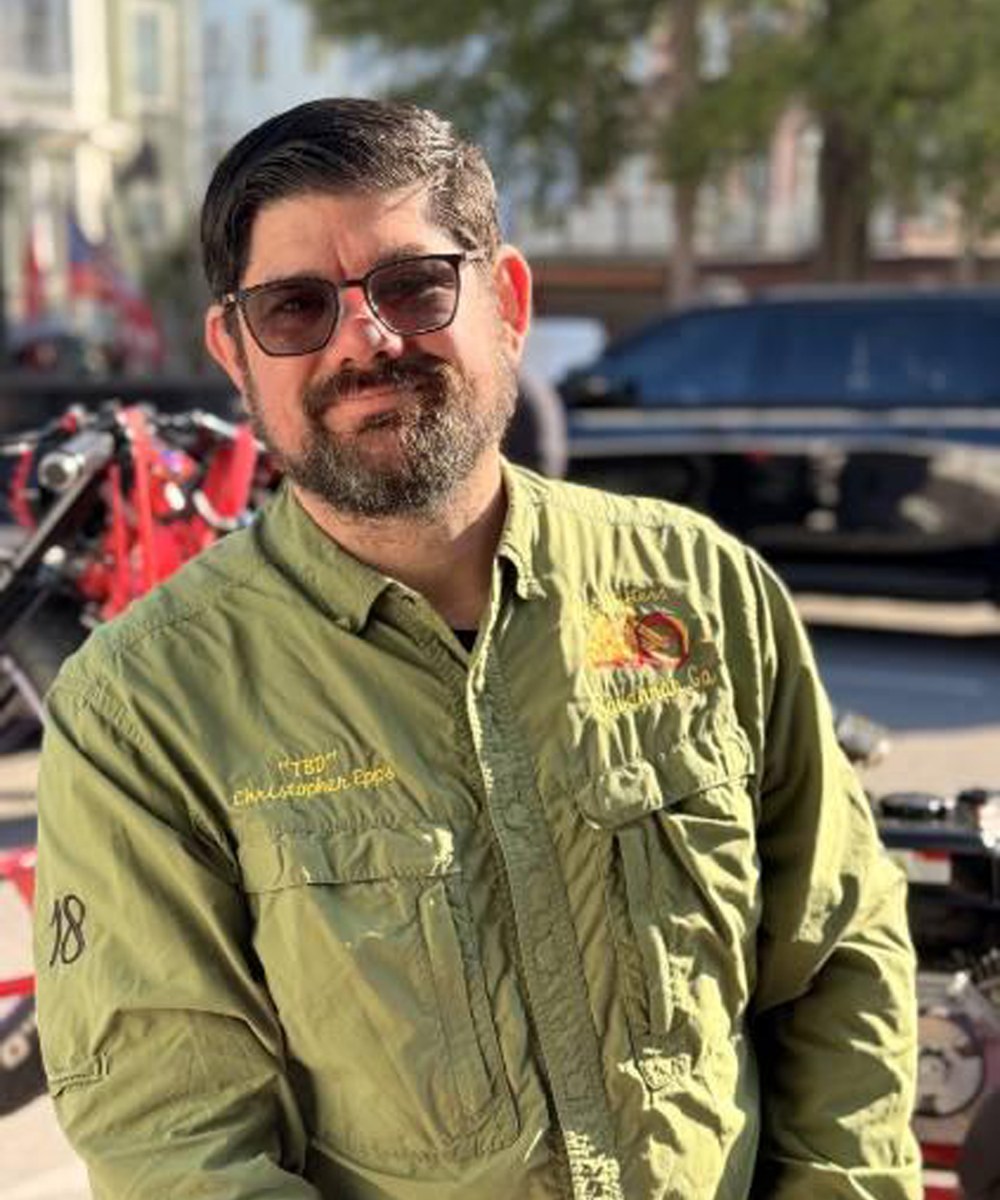
- Principal Architect, a Lowcountry architecture practice he founded in 2016
- Licensed Architect, South Carolina · NCARB certified
- M.Arch, Savannah College of Art and Design · SCAD Alumni Atelier Ambassador
- Advanced CPTED certified — crime prevention through environmental design
- Covert Methods of Entry, Red Team Alliance — physical security assessment
- 50-Ton Master Captain, U.S. Coast Guard
Christopher Ryan Epps is not a career software entrepreneur. He’s an architect. For more than a decade he has designed buildings, businesses, security systems, and community infrastructure — and architecture teaches one lesson above all: everything is a system. Security is a system. Traffic flow is a system. Lighting, behavior, approvals, neighborhoods — systems.
Running projects across clients, contractors, engineers, regulators, historic review boards, and municipalities, he watched the same failure repeat everywhere: people weren’t failing for lack of intelligence. They were failing because context disappeared. Knowledge fragmented. The same information was rebuilt over and over, at everyone’s expense.
He is also neurodivergent — autistic and ADHD, living with a traumatic brain injury. On his best days that means an unusual gift: whole buildings held and assembled in his mind before a model exists. On overload days, the gift locks behind glass. That perspective didn’t create the context problem — it exposed it earlier and more sharply than most people ever experience it, and made ignoring it impossible.
So he built the missing layer. Designed, coded, and operated by one person — the behavioral engine, the real-time pipeline, the GPU infrastructure, the governance — running on his own firm first, the way an architect stamps their own drawings. The first users happen to be neurodivergent. The mission is everyone.
The problem is measured, not anecdotal
A national survey of 417 employed autistic adults found the barrier isn’t ability — it’s the invisible workload layered on top of the job:
Source: NEXT for AUTISM, Inside the Autistic Workforce (n=417). Nearly seven in ten respondents rely on support built outside work to succeed at work — the infrastructure TALOS makes real.
of excess lost role performance per year for workers with adult ADHD — and most of it on days the person shows up: reduced quantity and quality of work, not absence. The cost isn’t the sick day. It’s the overload day. (WHO World Mental Health Survey, 7,075 workers, 10 countries; de Graaf et al., 2008)
estimated annual U.S. productivity and income losses from adult ADHD alone — before counting autism, TBI, or anyone undiagnosed. Corroborated a decade later: a 2021 societal-perspective study put the 2018 excess burden at $122.8B. (Doshi et al., 2012; Schein et al., 2021)
The evolution of the idea
- 2005–2016 — Construction, carpentry, boat design, and field architecture: learning how complex systems fail in the real world, at the level of screws and schedules.
- 2016–present — Founder of an architecture practice; projects up to $14M coordinating clients, contractors, engineers, regulators, and community stakeholders — and a decade of watching lost context tax every one of them.
- 2021–2025 — Deep work in CPTED, physical security, accessibility, and community leadership: confirmation that human behavior, viewed as a system, is understandable — and supportable.
- 2025 — The recognition: AI could be more than an answer engine. It could be a persistent contextual intelligence layer — the infrastructure understanding has never had.
- 2026 — Three patent filings, working prototypes in daily production, and the founding of Talos Cognitive Systems to build a cognitive operating system that augments people instead of replacing them.
- 2030+ — A world where cognitive continuity is as fundamental as search, the operating system, and the internet — and where owning your context is as normal as owning your files.
The world optimized access to information — and failed to optimize human understanding.
TALOS exists to close that gap: to make understanding persistent, private, and owned by the people it serves.
Amplify, never replace
Technology should extend human capability. The person stays in every decision, on every call, in every relationship.
Preserve knowledge
Institutional understanding is an asset. It should outlive turnover, tools, and time.
Privacy by design
Ownership of memory belongs to the people the memory is about. Structurally, not contractually.
Earn trust with transparency
Present-tense claims run in production. Future-tense claims are labeled. No exceptions.
Adapt to people
The system fits how people naturally think and communicate — especially the people other tools were never built for.
Restraint is respect
Surface nothing by default. Attention is the scarcest resource this platform touches.
Service is the through-line
The conviction behind TALOS — that people do their best work when someone builds the right support around them — runs through two decades of civic work in the South Carolina Lowcountry.
- Van Landingham Rotary Club — President-Elect; board member; Service Award, 2026; Paul Harris Fellow
- Boys & Girls Club of the Lowcountry — Regional Board Member
- Bluffton Lions Club — Founding President
- Foundation for Educational Excellence — Board Member & Grant Specialist
- Bluffton Historic Preservation Commission — Chair, professional seat (2013–2019)
- Shriners International — Member & Secretary, Alee Temple Drifters
Every present-tense claim on this site runs in production, on the founder’s own business, every day. The demo is his workday. Ask to see it →